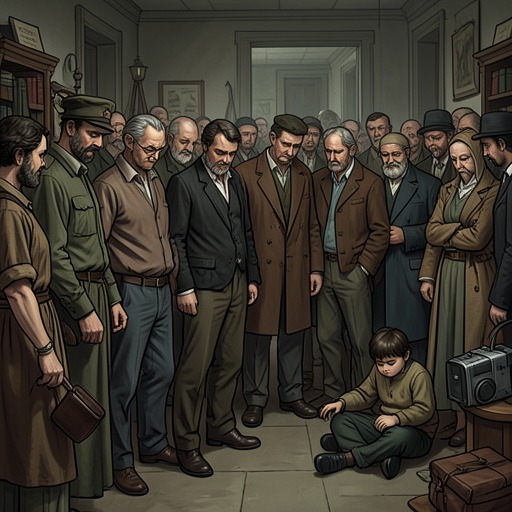
A day of the dead
Day of the DeadA day of the dead is the phrase Brian Fellows uses to describe what justice could still mean for murdered girls whose cases might never come to trial. In the exchange with Lani Walker, the phrase names both an absence—the girls were overlooked while alive and denied a day in court—and a small act of recognition: someone had finally looked for them, cared about what happened, and given their deaths attention. Its placement at the close of this conversation also gives the expression a direct connection to the book’s title, A day of the dead.
The phrase and its context
The exchange takes place during Brandon Walker’s recovery in the cardiac intensive care unit. Lani has spent hours in the waiting room over the preceding two days, holding Looks at Nothing’s crystals. Brian, away from work on administrative leave, has remained a constant presence. In those long hours, he has told her about the notebooks kept by Larry Stryker and about the devastation caused by Larry and Gayle Stryker’s crimes. The conversation therefore arrives amid both the immediate uncertainty of Brandon’s condition and the larger reckoning with crimes whose victims had been neglected. The investigation has connected Larry and Gayle to fourteen separate cases through DNA and previously unexamined fingerprint evidence. The notebooks contain photographs of additional dead teenage girls who have not yet been identified. These details give Brian’s phrase its particular weight: the number of known cases is already large, and the pictures point toward victims whose names and histories remain missing from the account. The phrase does not resolve that uncertainty. It marks what can be offered in the face of it.
From neglect to recognition
Brian’s grief is sharpened by the apparent indifference surrounding the girls. He says that nobody reported them missing and nobody went looking for them; once someone began properly working the cases, the evidence did not take long to sort through. His conclusion is that nobody cared. The contrast is stark: investigative progress came not because the cases were impossible to solve, but because they had gone unexamined. The failure lay in the absence of attention as much as in the delay of forensic work. Lani rejects Brian’s conclusion without disputing the girls’ neglect. She tells him that he and her father did care about them. Her response changes the scale of the conversation: the girls may not receive a courtroom hearing, but the investigators’ work means they have not remained wholly unseen. That distinction does not substitute for legal accountability. It identifies a lesser, still meaningful form of recognition, offered to victims whom the surrounding world had failed to search for.
The meaning of a day
Brian accepts Lani’s correction sadly, then calls the best they could give the girls a day of the dead. The expression holds their achievement and its limits together. The cases have been connected and the victims remembered by people who pursued the evidence, yet the girls may never have their day in court. Acknowledgment is not the same as justice; the phrase preserves that difference rather than disguising it. The wording also turns attention from the investigators’ discoveries to the people represented in the photographs. Brian says the images haunt him more than anything else he has seen. His distress is not presented as a solution to the girls’ fate, but it makes clear that learning about the victims has altered how he carries the cases. Lani’s gesture of taking his hand answers that burden with companionship, while her insistence that somebody cared refuses to let the girls’ neglect become the final measure of their worth.
Connection to the title
As a title-bearing expression, A day of the dead gathers this brief exchange into a statement about remembrance under conditions of incomplete justice. The phrase is not used here to describe a ceremony or to claim that the victims’ stories have been fully recovered. Its force comes from the immediate facts Brian and Lani discuss: unreported disappearances, unidentified girls, neglected evidence, and the people who finally pursued the cases. The day they can offer is small beside what was lost, but it makes the victims visible within the story. By ending on Brian’s phrase, the conversation leaves recognition as both a genuine act of care and an inadequate answer to the neglect that made it necessary.